Eagle Eye is an AI agent that watches the market day and night for you. It keeps track of Korea's used cars so you find the best deal first.
Why does that matter?
270,000 cars. You can't watch them all — and neither can anyone else. Local dealers and overseas buyers are combing through the same list, and the clean, well-priced cars go first. The weekly routine — same make, same years, same mileage cap, same budget, on one dealer site, then the next, then every auction house — is slow by design. The car you liked last Tuesday is already sold.
In a market this size, knowing first is the whole game. Anything that appears or gets cheaper after you set the criteria lands on the same page, flagged + new or ↓ dropped for 3 days. Eagle Eye puts the right car in front of you while it is still available.
Set It Once, Check One Page
With an Eagle Eye report, the deals find you — and you are among the first to know. Set your criteria once, then check one page. LMN keeps matching what you buy against Korean dealer listings and auction lots — prices in your currency, a timestamp that says how fresh it is — so the search runs without you. A car that fits shows up the next time the page updates, not the next time you remember to look, and before most buyers have run their weekly search. Open it on your phone, work through it, forward it to your own customer.
It is a list of what is for sale today, and what the sellers have published about it. It is not a physical inspection — for that, request LMN's secondary inspection on the one car you are serious about.
A Closer Look at the Report
Where the cars come from
Every report searches Korea's 5 major auction houses and its dealer listings together — around 270,000 cars in one search:
- 5 auction houses — Glovis, SK, Kolon Auto Auction (formerly AJ Autohub), Lotte and K Car: 6,000 to 9,000 new lots every week.
- Dealer listings — more than 260,000 cars for sale.
Report counts
Live example: a dealer's Eagle Eye list watching for every Mercedes-AMG GT 43, 53 and 63 4-Door from model years 2019 to 2023 for sale in Korea. The counts below are taken from it.
On Oct 28, 2026, the live example showed 17 new cars and 74 price drops in the last 3 days.
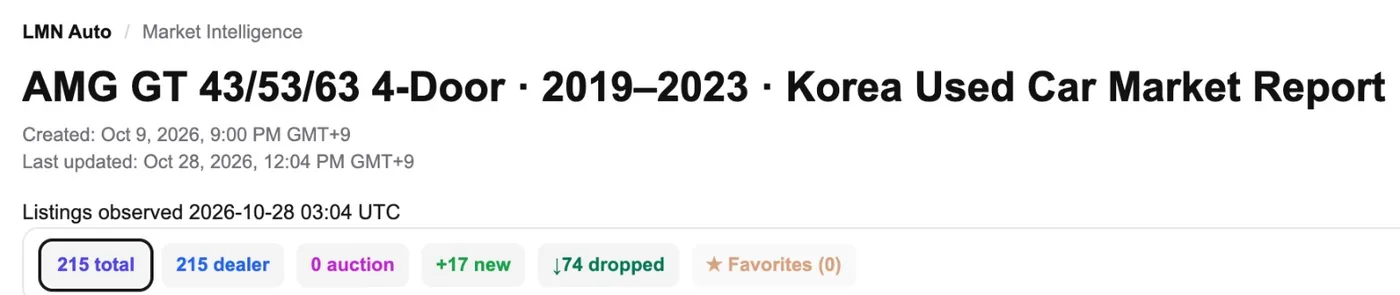
Under it sits a row of count pills, and each one is also a filter:
| Pill | What it means |
|---|---|
215 total | Every car currently in the list |
215 dealer | Rows from dealer listings |
0 auction | Rows from auction houses — zero here because no matching lot was scheduled when this was captured |
+17 new | First found in the last 3 days |
↓74 dropped | Price updated in the last 3 days, and lower than an earlier price |
★ Favorites (0) | The cars you saved |
The header shows when the report was created and when it was last updated, both in Korea time (GMT+9). The buyer's name and report date are removed from the title.
Click ↓ dropped and you are looking only at cars whose price fell in the last 3 days. Click + new and you see the cars first found in the last 3 days. Both windows are fixed at 3 days; they are not measured from your last visit.
There is one more pill you will sometimes see, and it is deliberately blunt: ⚠ dealer data 4d old. Dealer rows are re-checked on a regular cycle, so a gap of a day or more means LMN's checks have fallen behind for that list, not that the Korean market went quiet. Its tooltip reads "Dealer listings were last confirmed 4d ago. Auction rows may be newer." If that warning is up, treat the dealer prices as of that date and ask LMN before you act on them.
The table, column by column
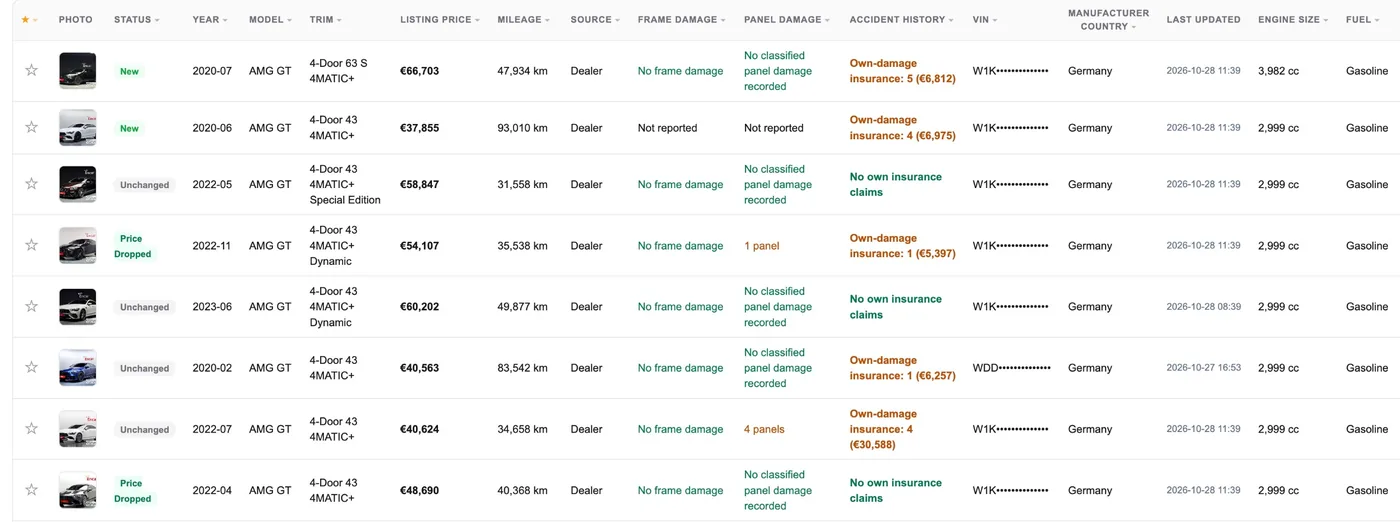
What the car is
- Photo — the listing's lead photo, so you can scan the list visually.
- Year, Model, Trim — the trim is also the link through to the full car page.
- Mileage, Fuel, Engine Size, Seats, Color — the specs buyers filter on.
- VIN and Manufacturer Country — country here comes from the VIN's manufacturer code, which can differ from where the car was assembled or where customs considers it from.
What it costs
- Listing Price — the asking price for a dealer car, the starting bid for an auction lot. An auction lot with no bid yet shows
—rather than a zero, and its Landed Cost stays blank with it. - Landed Cost — an LMN estimate built from the car's price plus auction fee, commission, and freight. If the price is unknown, this stays blank on purpose rather than showing a fee-only number.
- Price Change — movement since the car entered the list.
What condition is on record
- Frame Damage and Panel Damage — separate columns, because they are separate decisions. Frame work points to structural repair. Panel work is bodywork on a single panel; it is often cosmetic, but the column does not tell you how extensive the repair was or how well it was done. Both are reasons to look closer, not to assume.
- Accident History — the header says accident history, not insurance, because the houses publish different things. Glovis and Kolon (AJ) publish insurance-derived facts; K Car publishes repaired body panels, which is accident evidence but not an insurance record. Each cell's tooltip tells you which kind of evidence that row actually carries.
- Condition Grade — auction lots only: the grade the auction house published, a combined frame and exterior grade such as A/B. Grading scales differ by auction house, so compare grades only within the same house.
What the status labels mean
Every row carries a status, so you can see what moved without comparing lists by hand. The report has a "What do these mean?" control next to the Status filter, and it explains four:
- New — first found in the last 3 days.
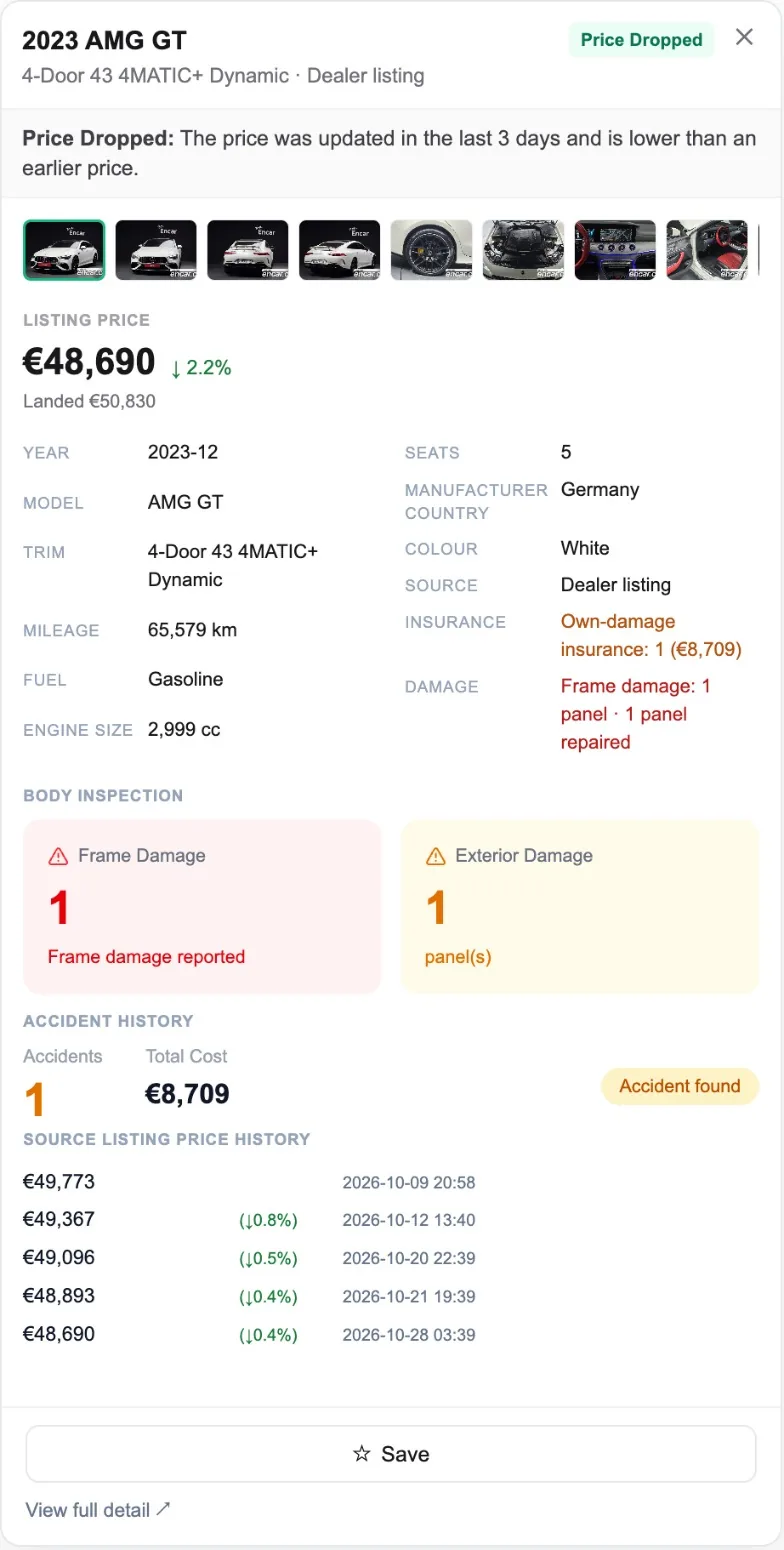
- Price Dropped — the price was updated in the last 3 days and is lower than an earlier price.
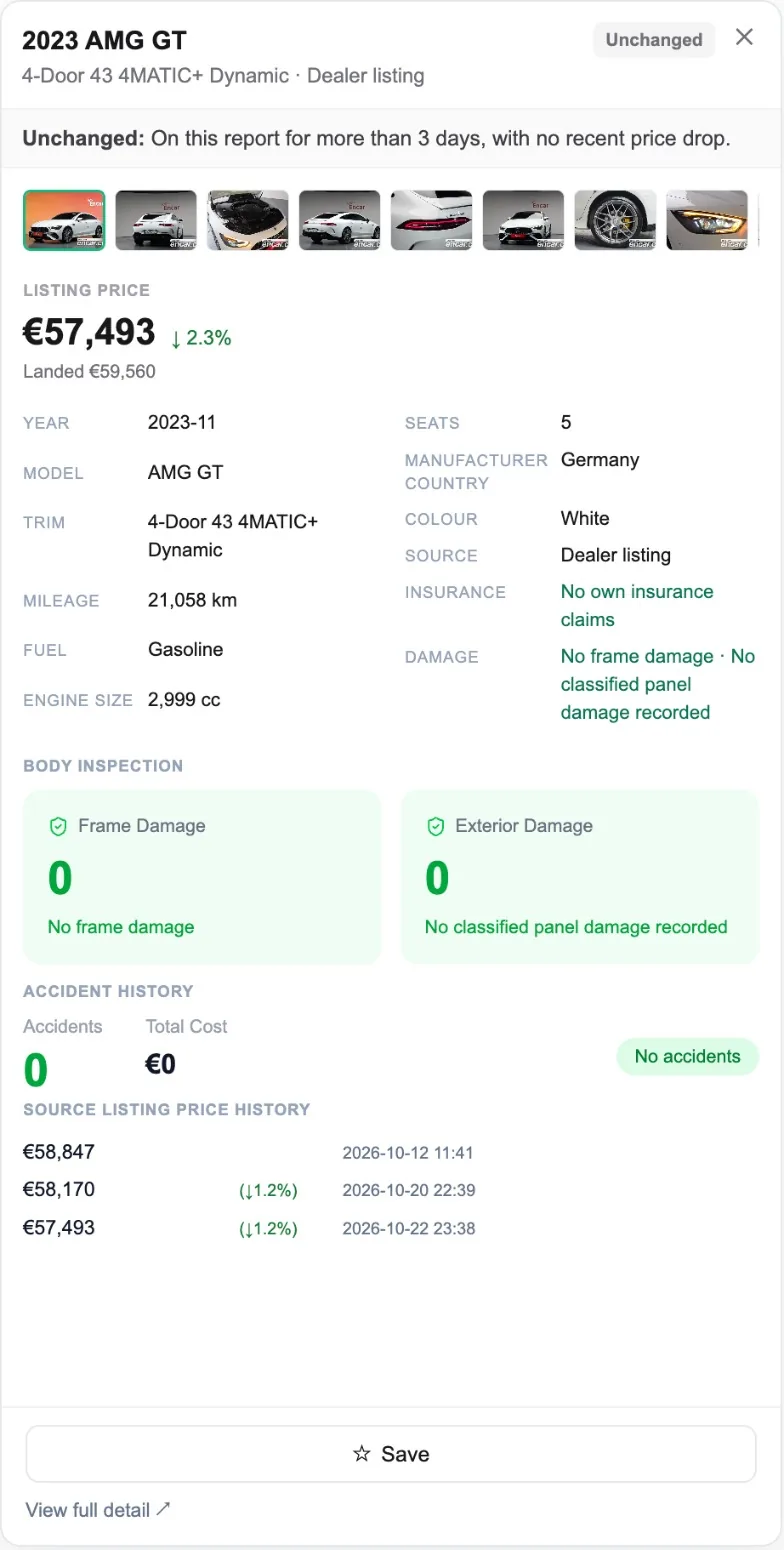
- Unchanged — on the report for more than 3 days, with no recent price drop.
- Under Contract — a buyer has a contract on this car. It can come back if the deal falls through.
Cars that drop out of the search — delisted by the seller, auction ended, or no longer matching your price ceiling — are removed from the list entirely rather than shown with a status. A car leaving your list does not mean it sold; it means the source stopped returning it, and the list is built to carry only cars you can still act on.
For cars with more than one recorded price, the report also keeps the price history, so a drop shows as a line rather than a single number.
See each car in detail
Click any car's row and a detail panel opens on the right: photos, specs, body inspection, accident history and the full price history, with a link to the car's full page.
Prices in your currency
Prices show in USD by default, or KRW, EUR and 18 other currencies. Converted prices and landed cost are estimates, not quotes.
How to request an Eagle Eye report
LMN creates the report for you. Send the criteria you actually buy on — make and model, model years, fuel, mileage and price ceilings, and any condition rule such as no frame damage — and LMN sets it up and sends back one link. The link does not change as cars come and go.
Partners already on the LMN Partner Console will find the same lists under Eagle Eye, where each saved search is called a watch. Watches are created through the Eagle Eye API or by LMN on your behalf, with webhooks available if you want match and price-change events pushed into your own systems.
Not ready to send criteria yet? Browse LMN first →
Frequently asked questions
What is an LMN Eagle Eye report?
A saved set of buying criteria that keeps matching Korean dealer listings and auction lots, published as one page you can open and share. In the Partner Console the feature is called Eagle Eye; the page itself is branded Market Intelligence by LMN Auto.
How often does it update?
Dealer rows are re-checked on a regular cycle, and auction lots are added on the auction houses' own release schedule. The page shows when it was last updated, and warns you on the page itself when dealer listings have not been confirmed for a day or more.
Does the report include an inspection?
No. It shows what dealers and auction houses publish, translated into English. A physical check of a specific car is LMN's secondary inspection, which you request for that car before you secure it.
What does "Not reported" mean in the damage and accident columns?
That the information is not available to the report for that car — either the source does not publish it, or LMN has not captured it yet. It does not mean the car has no damage history.
Why did a car disappear from my list?
Because the search stopped returning it: the seller delisted it, the auction ended, or it no longer matches your criteria. The list carries only cars you can still act on, so a car leaving it is not proof that it sold.
Is the Landed Cost my final price?
No. It is an estimate from the car's price plus auction fee, commission, and freight, meant for comparing cars. Your quote comes from LMN with your port and terms.
Can I share the report with my customer?
Yes. It is one link, built to be forwarded — unlisted rather than password-protected, so anyone you send it to can normally open it. If your report needs a sign-in wall, ask LMN.
Can I get the data into my own system?
Yes, for Partner Console partners: Eagle Eye has an API and webhooks for match and price-change events.