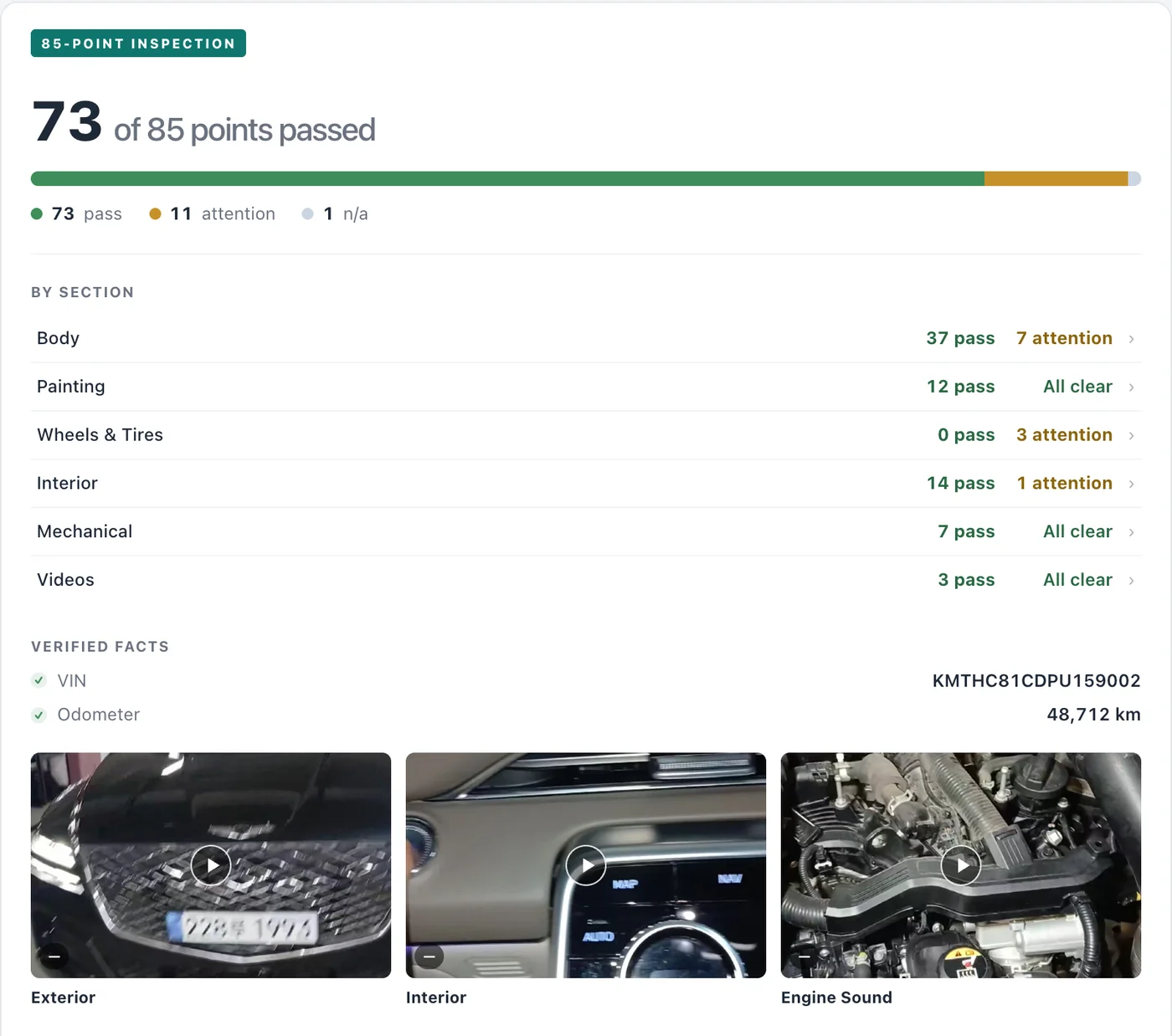
Everything on this page comes from one LMN inspection. Open it in a new tab to follow along.
Buying a used car in Korea from abroad has one hard problem: you can't stand next to the car. LMN secondary inspection closes that gap. Before you commit, LMN puts a person next to the specific car, checks it against a fixed checklist, and turns the findings into a shareable report of photos, video, and plain-English notes. It won't promise the car is perfect — it reduces the uncertainty so you decide on evidence, not hope.
Where this fits: the whole journey
Buying a car from Korea with LMN is six steps. This page is about the two in the middle — the inspection, and the report you decide on.
Steps 2–3 are the LMN secondary inspection — the focus of this page. It happens before you secure a car; the LMN facility process comes after. You request it for a specific car — it doesn't run automatically on every listing.
What LMN checks — 70+ points across six areas
Every inspection follows the same checklist, so one car can be compared to the next. Each area below is shown with cards from the sample report, a 2023 Genesis GV80: one photo per card, each stamped Pass or Attention. The counts on the right are that car's actual results.
1.Body
44 photos, 37 pass, 7 attentionChecked
- VIN plate, photographed and checked against the car.
- Every exterior panel: bumpers, hood, roof, trunk, fenders, doors, rear quarters.
- Inside each door: the door frame and the hinges.
- Hood hinges and fender bolts, so replaced or re-hung parts show.
What you learn
- Whether any panel is original, replaced, sheet-metal repaired or repainted.
- Whether the frame has been touched. A repaired frame is the biggest flag on a used car.
- Whether a door has been replaced or re-hung, from its frame, hinge and bolt paint.
- Where the scratches and dents are, each one photographed and flagged.

2.Painting
12 panels, 12 passChecked
- A paint-thickness gauge on every painted panel, including both B-pillars.
- Several spots on each panel, not one. A corner or edge that was touched up reads differently from the rest of the panel.
- The reading photographed on the panel, not typed in later.
What you learn
- Factory paint reads about 100–130 µm. A panel well above that, often 200 µm or more, points to a repaint or filler the eye can miss.
- Spot repairs show up too: one high reading on an otherwise normal panel means a local touch-up, not a full respray.
- A resprayed corner stands out at a glance, with the number right there.

3.Wheels & Tires
12 photos, 8 pass, 4 attentionChecked
- All four wheels, and the tread of all four tires, straight on.
- The sidewall of each tire: size, brand and the DOT date of manufacture.
- Front and rear brake discs.
What you learn
- Whether the tires need replacing now or later. This car: front tread at 10%, rear at 20%.
- How old the tires are, from the DOT week and year.
- How much brake disc and pad is left, front and rear. This car: front disc 40%, rear disc 50%, pads about 50%.
- Curb damage on the wheels, each scratch photographed and flagged.

4.Interior
15 photos, 14 pass, 1 attentionChecked
- Dashboard, cluster, steering-wheel controls, center console, sunroof, trunk.
- Front seats, upper and lower, and the rear seats.
- Keys, including card keys, and the side airbag labels.
- Whether A/C, windows, seats, speakers, sunroof and lights actually operate.
What you learn
- Stains, wear and damage on every seat and surface, seen rather than described.
- Whether the cluster and infotainment switch to English. This car's menus are shown in English in the grid below.
- How many keys come with the car.

5.Mechanical
7 checks, 7 passChecked
- Suspension at all four corners: shocks, control arms, bushings and drive-shaft boots, photographed from underneath.
- Engine bay and fluids: oil, coolant and any leak, with its location.
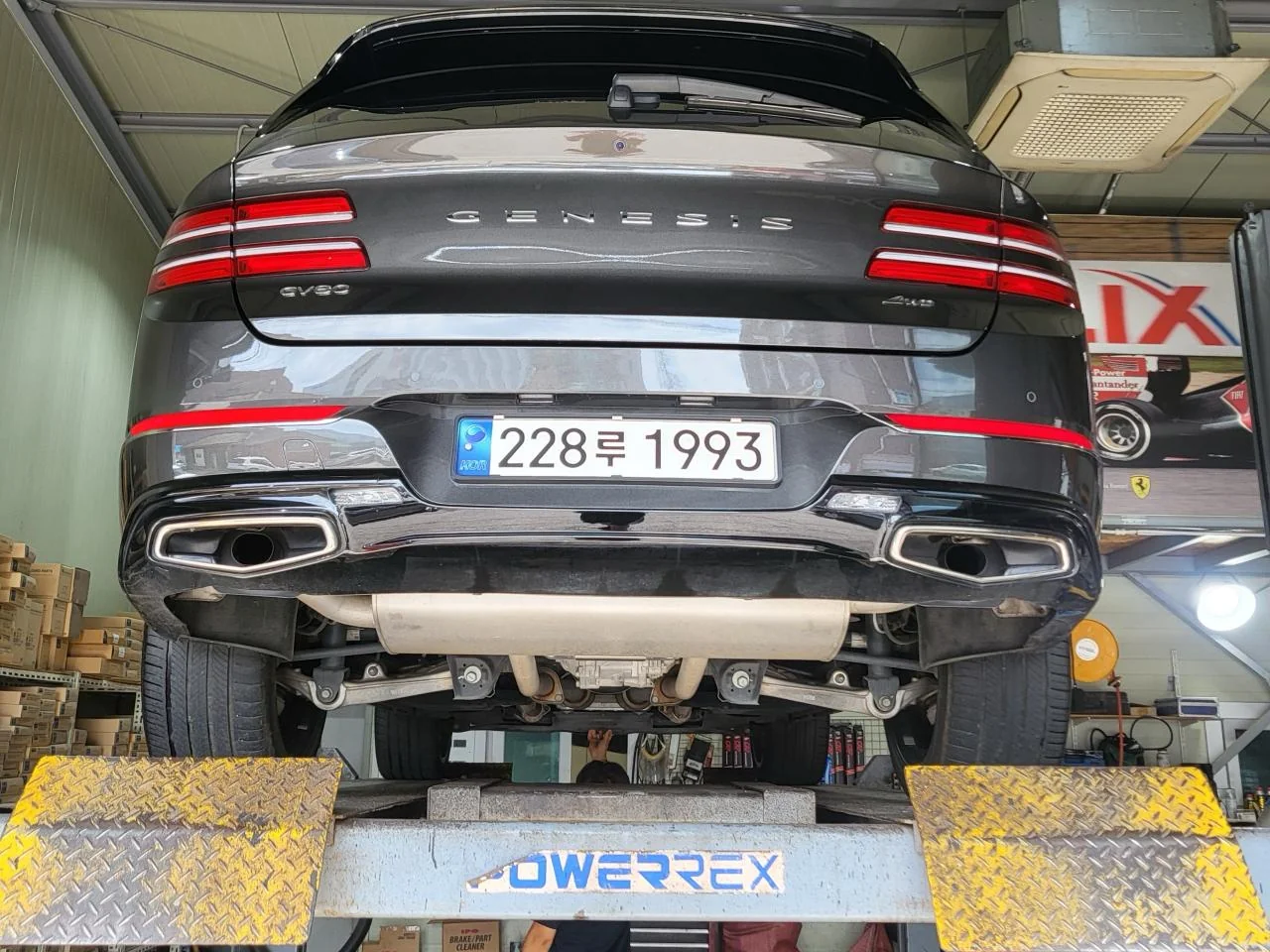
- Undercarriage on the lift, and a diagnostic scan where the car allows one.
What you learn
- A leaking shock, torn boot or damaged arm is visible, not just noted.
- Noise and vibration with the engine running, in the engine video.
- Fault codes read, cleared and re-scanned. If the scan can't be run, the report says so.

6.Videos
3 videosChecked
- Exterior walkaround.
- Interior walkaround.
- Engine start and running, with sound.
What you learn
- The whole car in motion, not just the angles someone chose to photograph.
- What the engine sounds like cold and at idle.
The three videos from the sample report, playable here. In the report itself they open full-screen.
The inspector's overall comment
Beyond the point-by-point checklist, every report ends with a plain-English summary from the inspector: the things that matter most, in the order a buyer would want them, including the honest caveats. Good notes keep three things apart: what was seen, what it probably means, and what couldn't be checked.
Certain
Right front fender replaced. Trunk: paint history.
Inference
Paint 130–180 µm, uneven. Likely a factory double-coat, not a repair.
Unknown
Couldn't run the diagnostic scan on this car.
A report that says what it couldn't determine is worth more than one that sounds certain about everything. This is the summary on the sample car, quoted from the report:
- No structural or exterior panel issues were found, and the overall exterior/interior condition is good.
- Engine room, undercarriage, and diagnostic scan results are good with no leaks or fault codes found.
- Notable findings include scratches on all 4 wheels, front tires at 10%, rear tires at 20%, and brake discs/pads with moderate remaining life.
- HDA2 option is confirmed.
What you get, and how fast
- One shareable report — photos, video, and plain-English notes for the specific car.
- Delivered within 48 hours of your request, and usually the next day.
- For any car at Korean auctions or dealer listings — you request it, car by car.
- History & documents on request: ownership history, accident records, insurance repair cost, and recall completion status.
The inspection itself is a paid service — a fee applies. It's evidence and observations made at the time of inspection, to inform your decision — not a certification, warranty, or guarantee of future reliability. The car isn't dismantled, and there's no road test unless one was specifically performed.
Need a partner in Korea?
If you're a dealer or buyer who wants to source from Korea but can't be on the ground, LMN can be your eyes on the car — the same inspection, on every vehicle, delivered as a report you can hand straight to your own customer.
- Consistent detail on every car — the same checklist and the same photo standard, regardless of who inspects it.
- Reports you can resell trust with — a clean, shareable page that makes your customer comfortable buying sight-unseen.
- Evidence, not hype — findings labeled as fact, inference, or unknown, so nobody is surprised on arrival.
Considering a car in Korea?
Request a secondary inspection before you secure it, and decide on evidence. After you secure a car, the facility process takes over. Start at lmnauto.com.
Frequently asked questions
What is LMN secondary inspection?
A pre-purchase inspection LMN performs on a used car in Korea before you secure it. LMN turns what it finds into a shareable report of photos, video, and plain-English notes, so you can decide whether to secure, negotiate, ask for more, or pass.
When can I request an inspection?
You can request it for cars listed at Korean auctions and dealers. It does not run automatically on every listing — you ask for the specific car you are considering.
How fast is the report?
LMN delivers the report within 48 hours of the request, and usually the next day.
Is this the same as the LMN facility process?
No. Secondary inspection happens before you secure a car, to help you decide. The facility process happens after, to prepare a car that is already yours.
Can dealers partner with LMN for inspections in Korea?
Yes. LMN acts as an inspection partner on the ground in Korea, inspecting each car to the same standard and delivering a report the dealer can share with their own customer.